Here is the second part of my interview with Rita Banerji (author and human rights activist). It is informative, powerful and thought provoking and I can't thank her enough for doing the work she does!!
(Rita Banerji)
Obviously the genocide against females in Indian culture is a systemic problem. It’s not just economics but something far more pervasive. In your opinion, why are women so devalued and dehumanised ?
As I argue and illustrate in my book, the female genocide in India is deeply rooted in the extremely misogynistic history, culture and religion (specifically Hinduism) of the country. All societies tend towards social hierarchies. And when a group (upper caste Hindu men for example) wants to establish dominance, and have the power over other groups (women and the lower caste) to exploit, to subjugate, and to annihilate at will – they establish a social logic, which even if inherently illogical, becomes the truth of the community’s existence. And the best way to reinforce this and make sure it isn’t challenged is to put it into religious law. Women and the lowest caste according to the Vedic texts are created from the dirtiest and lowliest part of the body – the feet. Hindu literature is littered with the most foul references to women – they are greedy, they have hearts of jackals, they are hideous wolves, deceptive, untrustworthy, evil sinners. There is also a very weird fear that the men had of female sexuality. They believed that menstrual blood for example could actually kill men. Furthermore, women along with slaves, deposits, houses, were officially recognized as “property” of men. It is the ultimate form of subjugation – commoditizing a human being. So like any other commodity – you can be bought, sold and disposed off at will! During a war a king could give his daughters to the invaders or attackers to ward them off. That’s why in the Mahabharata, Draupadi could be pawned off by her gambling husband, who had lost all his other property. There are hymns about female infanticide and sati in our religious books. Sita was found buried in a pot under the ground. That was not the earth giving birth – that is the earliest record of rescue of a girl who would have been a victim of female infanticide. It is how infant girls were killed in northern India.

(Music, mixed media on canvas, 16" x 20", SOLD)
Why is there such a disconnect between the reality of the way women are treated in society vs the Hindu custom of worshipping the Goddess? One of the misconceptions about Goddess-worship is that it is an indication of how much a society venerates women. Much of goddess worship, whether in India or elsewhere has to do more with fertility and reproduction as a male concern, than the status of women in society. Men have realized very early that women are their only means of self-propagation which is all through the Vedic literature an intense preoccupation with men. And specifically the production of sons. They believe that when women want to get nasty with them they produce daughters. So it is not women that they are worshipping, but their own desire for what the Hindu texts keep referring to as “immortality” (the son in the image of the man!) This is an extreme form of male narcissism. In fact most of the goddesses in the early Vedic literature – like Uma and Saraswati are passive and terribly bovine.
There is one period, the Shakta period, after 400 A.D., where goddesses like Kali and Durga emerge – and I do see and do a feminist interpretation of a lot of the literature from this cult and period, but what I also observe is that despite some of the underlying feminist philosophy of the religion, there is no apparent reflection of it in the social reality of the women of this period. The right of women as equal human beings in society is never addressed. In fact the legal rights of girls/women is never addressed in any matter. And the first time, this is ever addressed in India is under the British administration in the 1800s. It is one reason that even when I am approached by documentary film makers or journalists who want to do this “goddess angle” on the Indian female genocide – I refuse!
(Meenakshi, mixed media on canvas, 20" x 20", SOLD)
Once one is aware of the genocide/gendercide in Indian culture…is there anything that can be done? What can the average person do to raise awareness of the situation?
There is only one way to stop any kind of genocide. A genocide, because of its scale, intensity and systemic nature – always needs a highly organized, tightly coordinated, across-the-board system response. That has been true for any genocide in human history. Like I always say, if instead of women, India was annihilating people of a specific race, religion or ethnicity on this mass and systematic scale, what would the global response be? Why should it be different if the targeted group is being annihilated because of gender? And we keep saying gender! But really it’s women! If a nation hated boys and men and systematically targeted and wiped them out in the millions, and you ended up with 50 million more women than men in that country, I can bet you the international media would have revived the Amazonian myths with vengeance. I think the global response to India’s female genocide is in itself misogynistic.
Individually we each need to take responsibility for choices we make in our own lives, and how we respond to what we witness around us in our families, and communities. Violence is a major issue. But I’ll give you a small example. A lady I know who was a professor at the IIM – India’s elite management institute, was invited to her student’s wedding reception, but not the actual wedding. The reason was that this lady is a widow, and therefore according to Hindu beliefs considered to be an ‘unlucky’ presence at weddings. She was very hurt, but she went to the reception. I told her that if the most highly educated Indians don’t take a stand, what hope is there for us? She should have either not attended the reception and made it abundantly clear to the groom what she thought of this. Or she needed to have gate-crashed his wedding – and let him know she’s not taking this! In following the custom silently, what this professor did was she helped in the perpetuation of another ugly, destructive Indian custom. So, I think it’s very important how each of us responds. If you stay silent and go with the flow you are a part of the problem! This is true even for those non-Indians who come in contact with the Indian community through travel or work or friendship, and remain mute or follow customs – so as to ‘keep the peace’ or not offend the Indians! Why? Don’t you have an independent conscience?

I was introduced to
Dr. Shiva by Dr. Leslie Lovett-Doust, who is an ecologist and was also my freshman advisor. So that’s how I ended up in India as a Charles Dana fellow to do a project with her. I really liked working with her – because she gave me ample freedom and scope for individual judgment which I always need for any work I do. She gave me a couple of projects to choose from, and from there on I was on my own. I’d report to her once a week, and we’d discuss what I was doing and if there was any problem with anything.
I had to create a herbarium of the species of plants in a 1 km radius, to establish the biodiversity of the region, and do a general ecological survey of this subvalley called the Sisiyaru-khala valley (in the Doon Valley), where lime stone industrialists were strip mining the mountains. The locals helped me first classify the herbarium according to the folk system – which is entirely use based (like food, fuel, fodder, medicine etc.) And then I did a scientific (Linnaen) classification of it, and that herbarium was used as evidence in court. Two years later, I was in the U.S. when I got a letter from my friends in the village telling me that they had won the case against that particular quarry and it had been shut down! So that felt great.
Yes, it did have a big impact on me. I was veering towards genetics at that point in combination with ecology. But with the Chipco, the implication of eco-diversity in context of people, culture and lifestyles hit me in a big way. So when I eventually entered my Ph.D. program it was actually in conservation biology (more macro instead of micro – so I had evolution and ecology instead of genetics as tools of dealing with diversity and conservation).
The thing about Eco-feminism, as promoted by Dr. Shiva and many others is that it sees parallels between the productivity and the exploitation of women and natural resources by a virulently patriarchal society. And I think that as enthusiastic as I was about this at that time, as I grew older and got more into the field, my perspective on this has evolved. I think that communities like the one in Nahi-kala that are isolated, (they had no roads or running water), and are very dependent on their environment will naturally move to protect their environment because that’s survival for them. And yes, women do spend more time in the fields and forests, but in communities like this, and from my observation even in more urban, sophisticated settings there are men who are just as tuned in or connected to the ecological rhythms of nature. Conversely, there are just as many women in some rural and more so in urban settings who are not in tune with the ecological rhythms of nature. In the U.S., studying native American tribal philosophy on nature (the famous quote by Chief Seattle about teaching your children that we are connected to the web of life and what we do the earth we do to ourselves), I am convinced men can be just as connected. It is not a male/female thing.

(Music 2, mixed media on canvas, 30" x 40", SOLD)
Similarly on the issue of the plundering of nature. I remember sitting in a seminar class discussing the book “The Fate of The Forest” (about the Amazon), and there were 18 men, and 3 women (including me), and the professor was male too. And some of the male students went on and on about the “rape” of the “virgin” forest – discussing the forest like it’s female. And there was this terrible discomfort on the faces of the other 2 female students. So I pointed out the Amazon was second growth forest so not “virgin.” and I then asked whether the forest had to be female just because it was ‘virgin’ and ‘raped.’ “Aren’t there male virgins? And don’t men get raped?” I think that genderizing nature is not the way to go. Productivity, sensitivity, connectivity, are human things, not male/female things. When we genderize the world around us, we polarize our own experience of it through gendered glasses. So for eg. recently I was explaining to this group of men and women in India that with the gender gap increasing in India, rape has become the fastest increasing crime (it doesn’t automatically follow, but we have an inept system of law and order!). And the men looked at me and said – “that is a women’s thing.” So I asked them if I had said at any point that rape of women would increase. Did they know about the experiences of men in all-male prisons? When there are no women around, who do men rape? Each other!

The naturally occurring biological ratio of human societies is about 1:1 and is a bit more favorable towards women since they tend to live longer. Once you’ve screwed up the gender ratio, you’ve screwed it up for good! We have about 50 million more men than women in India. If we want to reverse this ratio and make it natural again – say 1:1 at least, then THE ONLY WAY TO DO THIS IS probably randomly select about 50 million families in India, and ask each of them to kill off a male of a specified age group in their respective families. You think India would be up for this project?
You started the 50 Million Missing Campaign. Can you tell us what inspired you to do this?
What inspired me? I’d say: anger and outrage. I’m an Indian woman, and my country looks me in the eye and says,
“You are nothing! We’ve eliminated your kind by the millions, like flies!” Just like that – totally cavalier, smug, wearing that hallowed, saffron crown! And it’s time to say –
“Enough! No more!”
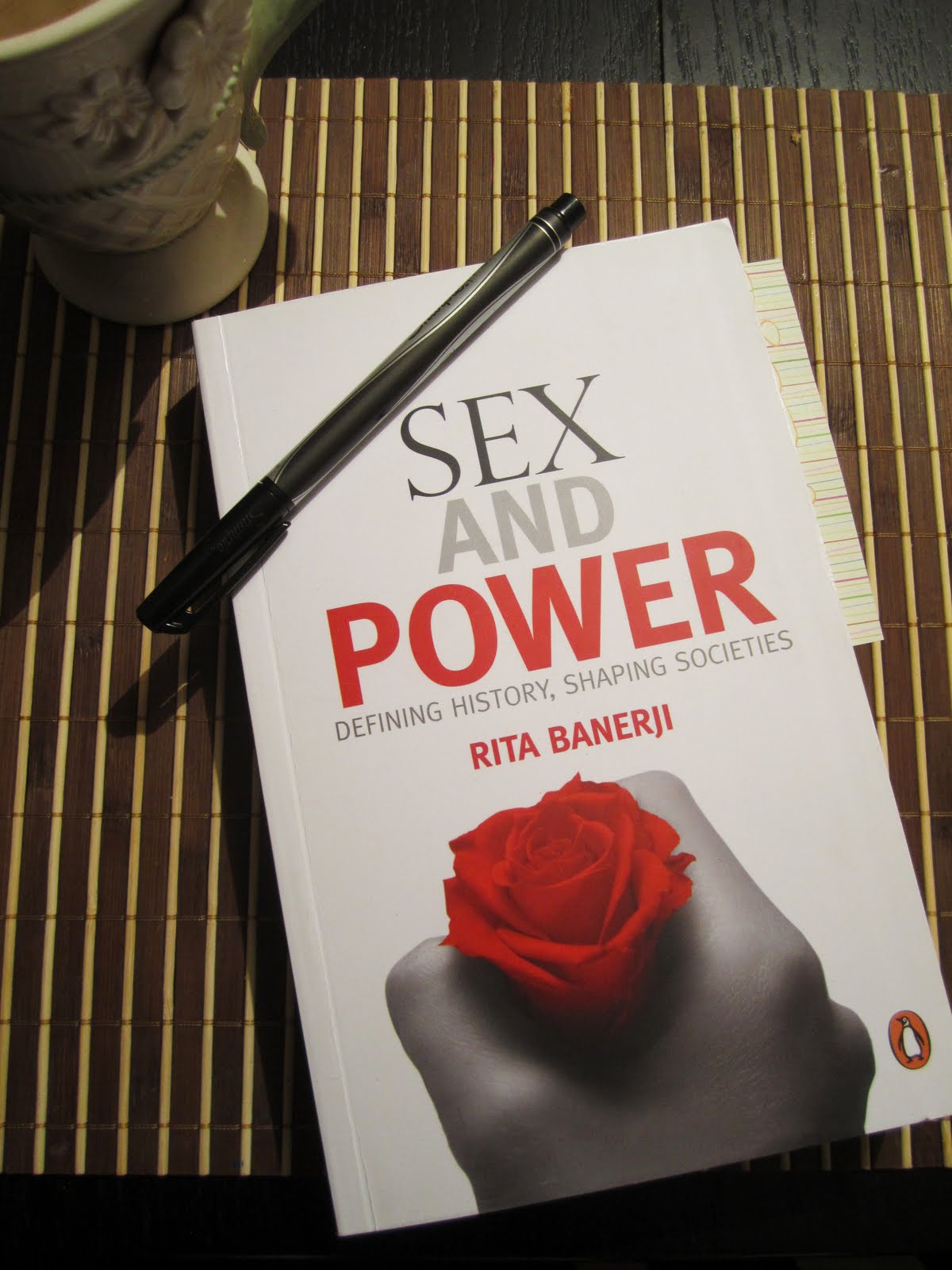
(Rita's Book-I just started reading it!)
Your book Sex and Power brings to light gender based inequities in our culture. How has it been received in India? I have come up against a thick wall of denial whenever I have spoken up about gender based violence in Indian communities. Have you ever faced this reaction regarding the work you do?
The research and citations for the arguments I make in my book are in great details, and the reviews have been very good for the book. So far I’ve not got a single counter argument. The resistance that I think I face is more with regards to the campaign, and it’s not direct, but it’s mute and almost sullen I think. The odd thing is I don’t get verbal counter-arguments. The reaction I face is usually one of people looking uncomfortable or agitated, and getting quiet and sullen. The wall of resistance is non-verbal. Or else, people like to say “Oh it’s changing!” And you say – yeah but in which direction? Most of these people don’t like to engage in any kind of an extended discussion. You need to be armed with your facts, figures and arguments, and they retreat into a brooding corner very quickly. And that’s because they already know what you are saying, but they are hoping that no one will say it out loud! Oh it’s denial alright or defensiveness. And I think this kind of an agitated response on the part of the audience is fine. In fact I think it’s good. The tendency to deal with female genocide in India is like how families deal with incestuous rape. Everyone knows, and everyone looks the other way, and continues pretending all is normal. Whenever we want to keep something secret – it is an indication of three things: 1) We all know it is wrong 2) we all know it’s happening 3)And we are all in one way or another being complicit and are therefore guilty. The discomfort means that there’s no place to hide. The secret can’t stay a secret anymore. India needs to embrace the shame instead of getting defensive about it. That’s the only road to change.

(Parvati, mixed media on canvas, 24" x 24", SOLD)
Is there any one person or experience that encouraged you to do the work you do today?
Oh goodness! This is something else. I know I keep seeing things about “positive role-models” particularly for girls. And it’s not an approach I support. Because I think in an inverted way it perpetuates the conventional method of providing prototypes for girls and women to model themselves on – “the good girl” “the ideal wife.” It tells you what to be and how to do it. And I think that ultimately whatever a girl or woman chooses to do or be has to be determined and visualized from within. If Mother Teresa did something, or Hilary Clinton, that is uniquely them. It is determined by their experiences, their vision, and their abilities and limitations. But no girl or woman should want to be like Mother Teresa or Hilary Clinton. They should want to be themselves in whatever way is uniquely suited to them and desired by them, which could very well be completely at odds with how Mother Teresa or Hilary Clinton would do it. If a woman wants to marry, grow a kitchen garden and raise a family – and find her real meaning of life and contentment in that, as her ultimate goal in life, I think that’s as important and fulfilling as what mother Teresa did or Hilary Clinton. As long as this woman chooses to do this as a deeply desired and seriously thought out choice and not because she was terrified of doing what she really wanted to do, and this seemed the simplest “formulae” lifestyle that society offered her.

(Music 1, mixed media on canvas, 16" x 20", NFS)
My work with the 50 Million Missing Campaign, stems from my own outrage and compulsion. I’m Indian, and I’m a woman, and my country looks me in the eye and says, “So what! We’ve swatted 50 million flies like you!” Even more so I’m amazed at the global response. When Jews were being annihilated in Europe, Jewish people all over the world were outraged, as were decent people. When the Tutsis in Rawanda were been slaughtered, black people all over the world, African or not were angry at the U.N. for not responding. And so I keep wondering, why does the systematic annihilation of women in India not outrage women around the world? The odd thing is – women’s groups get angry and agitate when minorities are targeted of a race or religion. But they don’t respond the same way when women are being exterminated. Instead they offer these weeded, Florence Nightingalian suggestions. Like “educate them,” “economically empower them.” Would they make these suggestions for religion and race based genocides? No they wouldn’t! Because these are never the reasons and these are not therefore the solutions of any genocide! It would be thoughtless, naive and obscene! So why do we have this weeded, yet fundamentally apathetic approach to female genocide? It’s questions like these that compel me.
Dear Rita-thank you so much for such an amazing interview!
*to read the first parts of her interview, go
here and
here
*to sign the petition against the genocide against India's girls go
here
*to find out more about Rita go
here and
here
* to find out more about Rita's book, Sex and Power, go
here
*******************************************************
my blog has been given an honourable mention
here...thanks so much!